
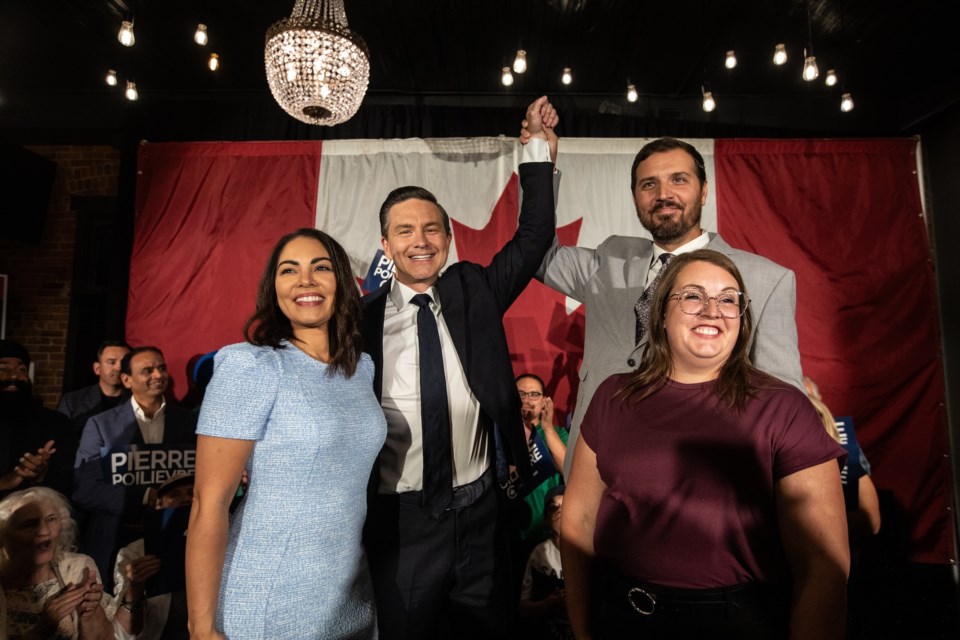
Conservative Leader Pierre Poilievre mounted a successful political comeback by securing a safe Conservative seat in Alberta, closing the loop on a stinging defeat that saw him kicked out of Parliament in April.
Poilievre sailed to victory in Monday evening’s Battle River—Crowfoot byelection, winning 80 per cent of the vote.
The riding has been a Conservative stronghold since its inception, with Damien Kurek holding it since 2019 before he volunteered to step aside to let Poilievre run. Kurek, who has since joined Upstream Strategy Group as a principal, says he plans to run again for the seat in the next general election. He defended the riding in the general election with 82 per cent support.
Poilievre thanked Kurek on election night for making the byelection possible.
"Getting to know the people in this region has been the privilege of my life,” Poilievre said. “In fact, I’ve had a hell of a lot of fun.”
Back in the saddle. pic.twitter.com/Ky2SrqhibR
— Pierre Poilievre (@PierrePoilievre) August 19, 2025
Kurek appeared alongside Poilievre during many of his campaign events in a bid to reassure constituents that the party captain, who represented an Ottawa-area region since 2004, was aware of their local concerns. It’s a theme Poilievre echoed throughout the campaign, downplaying some of his contenders’ criticism and vowing to bring national leadership to local issues.
According to Elections Canada, an estimated 14,000 electors cast a ballot during the advanced polls — about the same number who did so in Poilievre’s Carleton riding during the federal election’s advanced voting.
The agency previously predicted that it could take longer for final results to be confirmed, given the record number of candidates running in the byelection.
Over 200 people put their names forward, most of them as protest candidates pushing for electoral reform. This prompted the agency to provide blank ballots requiring electors to write out the name of their preferred candidate.
Poilievre spent much of the campaign framing himself as the best person to lead a “government-in-waiting,” signalling he wants another shot at unseating the Liberals, who captured a fourth consecutive mandate under Prime Minister Mark Carney earlier this year.
He is now gearing up to return to the House when MPs begin the fall sitting on Sept. 15, and will assume the party’s parliamentary leadership duties from interim captain Andrew Scheer, who held down the fort after Poilievre failed to defend his longtime Carleton riding less than four months ago. He could also rejig his front bench in the lead-up to that date, given his party picked up dozens of new ridings in the April vote and he’s been shoring up support ahead of a leadership review in January.
While some veteran MPs have expressed confidence that Poilievre can hang onto the top job, given a lack of public challengers, some sources were said to be watching his performance in Alberta to see how he changed his strategy since the April vote.
It remains unclear who will form that new inner circle, given Jenni Byrne announced last week that she would not run the party’s next national campaign — though she plans to stay on as an adviser.
Earlier in the day, Ontario Premier Doug Ford was asked about Poilievre’s byelection run after his meeting with Carney on the Hill.
Commending Carney for working "collaboratively" in the face of trade tensions with U.S. President Donald Trump, the premier urged Poilievre to adopt a similar approach.
“Work with the prime minister. It’s Team Canada, let’s put our political stripes aside and let's start working together collectively on large infrastructure projects and other areas that he can co-operate with the government (on),” Ford said when pressed about his advice to Poilievre.
Tensions between the federal party and Ford’s Ontario PCs made headlines throughout the campaign, with some close to Ford describing Poilievre as too similar to Trump. While Poilievre has rejected those accusations, Ford remained mum on whether he plans to meet with Poilievre to further a message of co-operation.
Instead, Ford insisted that the person he’s working with “right now” is Carney, who’s doing a “really, really good job considering the position he’s been put in” with Trump.
“I challenge anyone to try to deal with Donald Trump, myself included. He's a different type of cat. But we’re united,” Ford added.